Adaptive Randomization
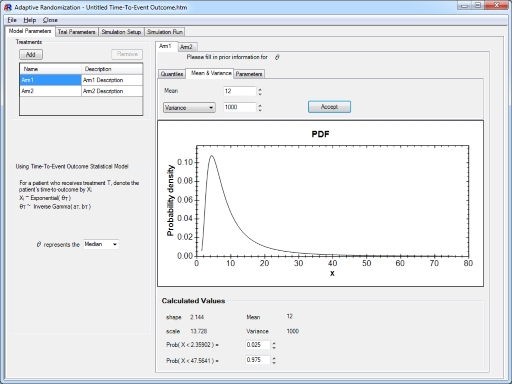
This software simulates randomized clinical trials in which the randomization
probabilities adapt in response to the outcome data. More patients are treated
with the better treatment while retaining the benefits of randomization. The
software supports both binary and time-to-event outcomes. Numerous design
options are supported.
The software supports up to 10 arms. Stopping rules may be based on a maximum
patient accrual or maximum trial length. Optionally one may specify a minimum
number of patients in the trial. Also, one may specify the number of
patients to randomize fairly before adaptive randomization begins. Stopping
rules are based on posterior probabilities.
The trial design contains a tuning parameter to control the degree to
which the randomization probabilities respond to data. If this parameter
is set to zero, the "adaptive" randomization is actually equal
randomization. The larger the value of this parameter, the more the
randomization favors what appears to be the better treatment. See the report
[1] examining the role of this parameter on operating characteristics and
giving guidance for selecting its value. See also [2] for a comparison of
this tuning parameter to other methods of controlling the randomization
probabilities.
The
Adaptive Randomization user's
guide
is available here and also included with the software. See [3] for a study
of the operating characteristics of adaptively randomized clinical trials.
See
Block ARAND
for adaptive randomization with blocks. See also our
Predictive Probability software
for interim analysis of randomized trials.
See [5] for a description of the algorithm used for calculating
time-to-event randomization probabilities. Algorithms for calculating the
other randomization probabilities are described in [6].
For questions concerning this software please contact
Biostatistics Software Support
.
Odis Wooten and J. Kyle Wathen developed the user interface using C# and
the Microsoft .NET Framework version 2.0. J. Kyle Wathen implemented the
original simulation kernel using Visual C++.
Thomas Liu and James Martin assisted in writing unit tests for the project.
Clift Norris, John Venier, and Ren Zheng updated the software, fixed bugs,
and provided other enhancements using the .NET Framework 4.0 and Visual
Studio 2013.
References
[1] John D. Cook, Understanding the Exponential Tuning Parameter in
Adaptively Randomized Trials (2006). UT MD Anderson Cancer Center
Department of Biostatistics Working Paper Series. Working Paper 27.
[2] John D. Cook, Comparing Methods of Tuning Adaptively Randomized
Trials (2007). UT MD Anderson Cancer Center Department of
Biostatistics Working Paper Series. Working Paper 32.
[3] J. Kyle Wathen and John D. Cook. Power and bias in adaptively
randomized clinical trials (2006). Technical Report UTMDABTR-002-06.
[4] Peter F. Thall and Jay K. Wathen, Practical Bayesian Adaptive
Randomization in Clinical Trials (December 2006). UT MD Anderson
Cancer Center Department of Biostatistics Working Paper Series.
Working Paper 31.
[5] John D. Cook. Numerical evaluation of gamma inequalities
(2006). Technical Report UTMDABTR-001-06.
[6] John D. Cook Numerical Computation of Stochastic Inequality
Probabilities
(2003)
Technical report UTMDABTR-008-03