EffTox
This computer program provides a basis for constructing, simulating, and conducting
the EffTox phase I-II clinical trial design described in the paper “Dose-finding
based on efficacy-toxicity trade-offs”, Thall and Cook, Biometrics
60:684-693,2004 [1]. Please read this paper before using
this program, which implements the trial design, simulation, and conduct. Please
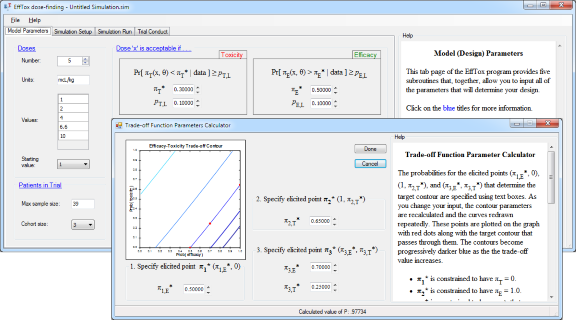
note that as of version 4.0.0 very important improvements/refinements have been made in two key elements,
(1) the prior and (2) the trade-off contour. These are explained in the tutorial,
available here and
in the computer program.
What's New in Version 5.2.3
Requirements
- Windows 11
(other Windows versions may be compatible but this has not been tested)
- Administrative permissions may be required to install EffTox depending on the chosen
installation location.
- The following packages will be installed if they or compatible replacements are not present:
- Microsoft .NET Framework 4.8.1
- Microsoft Visual C++ "14" Runtime Libraries (x86)
- To view the trade-off
function details a PDF file viewer (not included with the software) such as
Adobe Reader (available for free here)
must be installed.
- To follow the "Send feedback via email" link in the Help -> About EffTox...
window, an email client such as Microsoft Outlook (not included with the software)
must be installed.
Clift Norris developed the original user interface using
C#
, C++, and the Microsoft .NET framework version 1.1. John Venier, Clift Norris, Richard
Herrick, and Juan Posadas developed the current user interface using
C#
, C++, and the Microsoft .NET framework version 4.8.1.
John Cook implemented the original
simulation kernel using Visual C++. John Venier, Clift Norris, and Richard Herrick modified it.
References
[1]
Peter F. Thall and John D. Cook. Dose-Finding Based on Efficacy-Toxicity
Trade-Offs. Biometrics 60, pp.
684-693, September 2004.
[2] Peter F. Thall and John D. Cook. Adaptive dose-finding based
on efficacy-toxicity trade-offs Encyclopedia of Biopharmaceutical Statistics,
2nd Edition. Chein-Chung Chow editor. 2006
[3] Peter F. Thall, John D. Cook, and
Eli Estey. Adaptive dose selection using efficacy-toxicity trade-offs: illustrations
and practical considerations.
Journal of Biopharmaceutical Statistics Vol 16, No. 5, pp. 623-638,
2006.
